The Syria civil war is one of the most devastating conflicts of the 21st century. It has reshaped the country, displaced millions of people and created one of the world’s largest humanitarian crises.
Here, we explain when the Syrian crisis began, how it has affected civilians and why humanitarian support remains essential today.
The Syria civil war began in March 2011 after peaceful protests against President Assad turned violent in the southern city of Daraa. Protesters were calling for greater political freedoms and an end to corruption.
When Syrian security forces responded with violence, unrest spread across the country. Over time, the situation escalated into an armed conflict that became known globally as the Syria civil war.
SAMS response:
The Syrian American Medical Society (SAMS) began expanding its medical operations in Syria in 2011 as the crisis unfolded. Today, SAMS operates more than 65 medical facilities across six governorates, delivering over 9,000 medical services each day to communities affected by conflict and displacement.
Before 2011, many Syrians faced high unemployment, rising living costs and limited political freedoms. Public frustration towards the Syrian government had been building for years.
When protests were met with force, armed anti-government groups began to form. What began as peaceful demonstrations evolved into a complex and prolonged conflict involving multiple factions inside Syria.
306,887 civilians killed
between March 2011 and March 2021

600,000+ total deaths
estimated by monitoring groups since 2011

16.5 million people
inside Syria currently require humanitarian assistance

7.4 million people
remain internally displaced

4+ million refugees
registered in neighboring countries

More than 600 attacks
on medical facilities documented since 2011
71% of the population
now requires humanitarian support
The Syria civil war has never been a simple two-sided conflict.
It began as an uprising against the Syrian government. Over time, numerous armed groups emerged, including opposition factions, Kurdish-led forces and extremist organizations.
Regional and global powers have also played a role, supporting different sides at various points during the conflict.
The result has been a fragmented war with shifting frontlines and no single clear battlefield. Civilians have found themselves caught between competing forces, facing constant danger, disrupted lives, and limited access to food, healthcare, and shelter.
The human cost of the Syria civil war has been devastating.
According to the United Nations Human Rights Office, an estimated 306,887 civilians were killed between March 2011 and March 2021 as a direct result of hostilities. The UN stressed that this figure does not include those who died due to lack of access to healthcare, food or clean water.
Other monitoring groups, such as the Syrian Observatory for Human Rights, estimate that more than 600,000 people have died in total since 2011.
Behind every number is a person, a family and a community changed forever.
SAMS response:
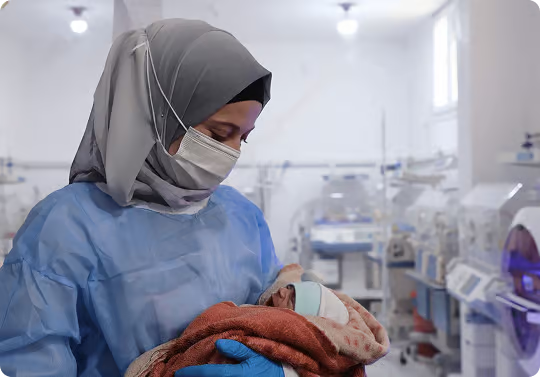
In response to this immense toll, SAMS has delivered millions of medical services since 2011, including emergency surgeries, maternal and newborn care, mental health support and treatment for chronic illnesses. Its programs also support cancer and dialysis patients, whose treatment would otherwise be interrupted by conflict and infrastructure collapse.
The Syria civil war has displaced more than half of the country’s pre-war population.
The United Nations reports that over 16.5 million people inside Syria now require humanitarian assistance, the highest since 2011 and representing 71% of the population.
Access to healthcare has been severely disrupted. Physicians for Human Rights has documented over 600 attacks on medical facilities since 2011, highlighting the extreme challenges faced by healthcare workers.
Homes, schools, water systems and hospitals have been damaged or destroyed. While entire neighborhoods have been reduced to rubble.
While levels of active fighting have fluctuated in different regions, the Syrian civil war is not fully resolved. Some areas have experienced relative calm, while others continue to face instability and insecurity.
In late 2024, opposition forces made rapid advances across several major cities, leading to significant political changes in parts of Syria. These developments marked a major shift after more than a decade of the Syria civil war, but they also created uncertainty in many communities.
Some displaced families have begun cautiously returning home. However, many are finding damaged properties, limited public services and fragile security conditions.
Even where active fighting has decreased, essential systems such as healthcare, education and water infrastructure remain under severe strain. As a result, millions of people continue to depend on aid for food, shelter and medical care.
SAMS response:
Through our Syria Health 2030 initiative, SAMS is combining emergency relief with long-term recovery. This includes rehabilitating hospitals, expanding ICU capacity, strengthening supply chains and training healthcare workers to rebuild resilient local health systems.
Even after more than a decade, the consequences of the Syria civil war are still unfolding.
Economic hardship is widespread. Many families struggle to afford basic necessities such as food, fuel and medicine. Infrastructure remains fragile in many areas, and access to clean water and reliable electricity is limited.
Children have grown up knowing only conflict and displacement. The UN estimates that millions of Syrian children need humanitarian assistance, with many at risk of interrupted education and long-term trauma.
Healthcare systems, already under strain, continue to face shortages of equipment, supplies and trained staff.
Throughout the Syria civil war, medical professionals have worked under extraordinarily difficult conditions.
The Syrian American Medical Society (SAMS) provides lifesaving and life-sustaining healthcare to people in Syria and in neighboring countries hosting refugees. SAMS supports hospitals and clinics, delivers emergency care and trains healthcare workers.
In areas where facilities have been damaged or overwhelmed, SAMS teams help ensure that families can still access essential services, including maternal health, surgery, mental health support and chronic disease treatment.
The Syria civil war may no longer dominate headlines in the same way it once did. But for millions of Syrians, the crisis is not history - it’s daily life.
Humanitarian needs remain at record levels. Rebuilding health systems, restoring services and supporting displaced families requires sustained commitment.
By donating to SAMS, you can help deliver critical medical care to people who need it most.
Your support helps provide medicines, equipment, trained staff and emergency response in some of the most challenging environments.
With continued compassion and support, recovery in Syria becomes possible.

Your donation can provide medical care and hope to families in need.